Your .com.au Domain Could Disappear Overnight — Here's How to Prevent It
A client's website went down because their company details changed and they didn't update their domain registrar. Here's what happened, why .com.au domains are different, and how to make sure it doesn't happen to you.
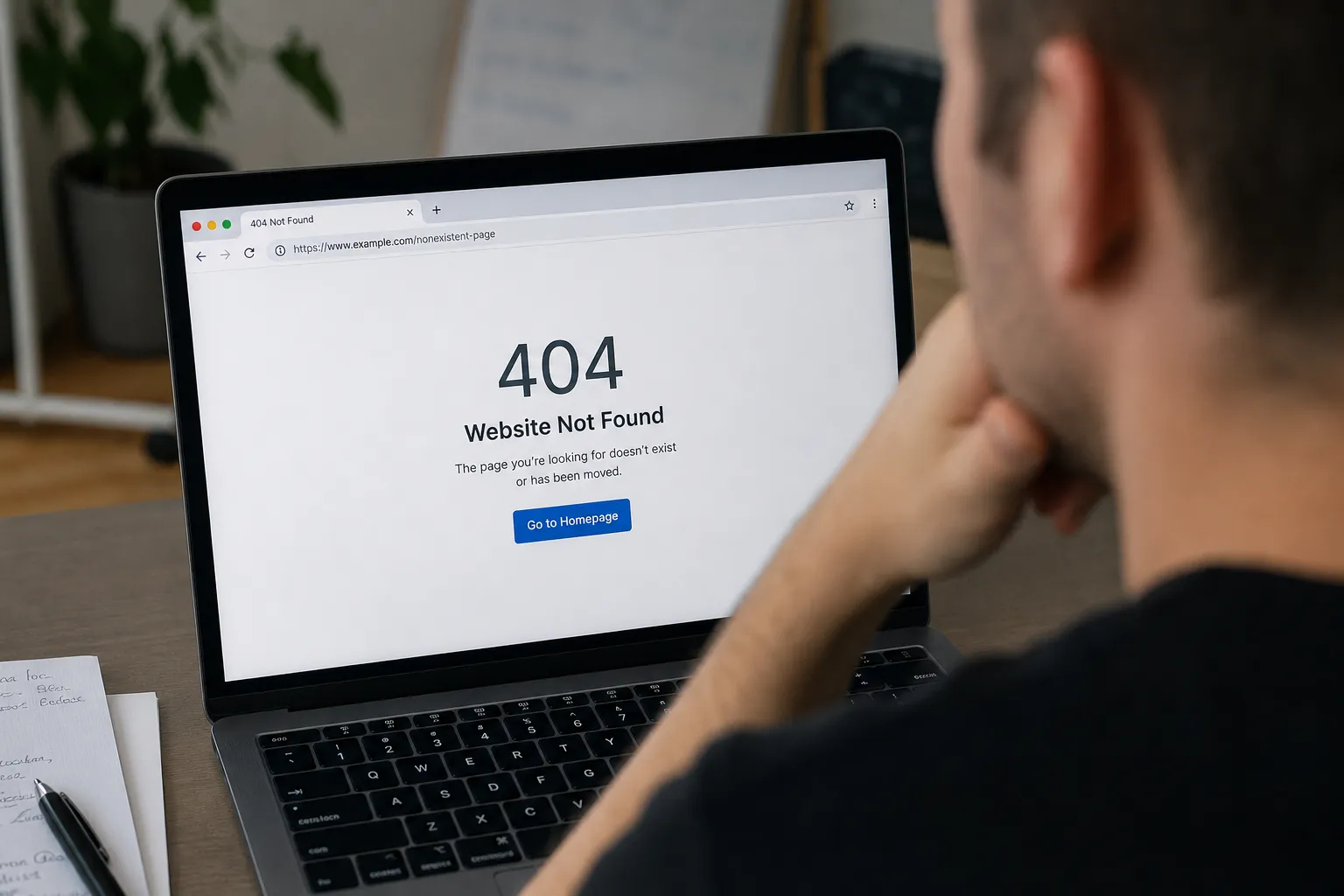
I got a call from a client this morning. Their website was down. No warning, no error emails, no heads-up from their hosting provider. Just — gone.
Turns out, their business had gone through a company structure change a while back. New ABN, updated entity name, the usual stuff you deal with when restructuring. They updated the ATO, they updated their bank, they updated their insurance. But they didn’t update their domain registrar.
Their .com.au domain was tied to an ABN that was no longer active. And when the registrar ran its periodic eligibility check, the domain failed — and it was suspended.
Why .com.au Domains Are Different

If you’ve ever registered a .com or .net domain, you’ll know it’s pretty straightforward. Pay the fee, it’s yours. No ID check, no business number required.
Australian .com.au domains don’t work that way. They’re governed by .au Domain Administration (auDA), and there are strict eligibility rules. To hold a .com.au domain, you need to be:
- A registered Australian company (with a valid ACN), or
- A registered business name holder (with a valid ABN), or
- A sole trader, partnership, or other entity with an active ABN
Your domain name also has to be closely related to your business name, trading name, or ABN. It’s not like a .com where you can register anything you want.
The key word in all of that is active. If the ABN or ACN linked to your domain becomes inactive, cancelled, or doesn’t match your current entity — your domain becomes ineligible. And ineligible domains get suspended or deleted.
What Actually Happens When Your Details Don’t Match
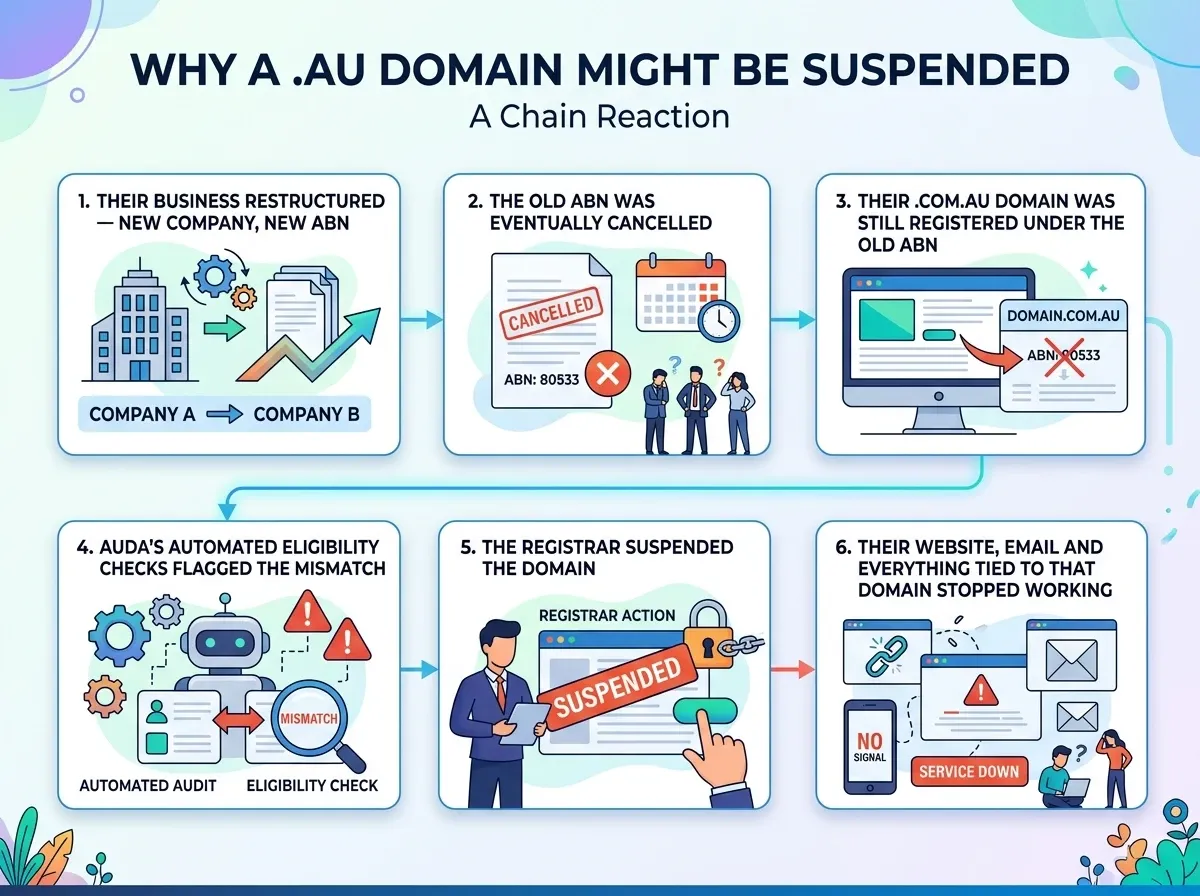
Here’s the sequence of events that caught my client off guard:
- Their business restructured — new company, new ABN
- The old ABN was eventually cancelled
- Their .com.au domain was still registered under the old ABN
- auDA’s automated eligibility checks flagged the mismatch
- The registrar suspended the domain
- Their website, email and everything tied to that domain stopped working
This is the kind of thing that regular website maintenance is supposed to catch — but most businesses don’t think of domain registration as part of maintenance. They should.
There was no grace period they noticed. No phone call. There may have been an email to the registrant contact address — but if that email address is on the domain that just got suspended, you’re not going to see it.
It’s Not Just Company Changes
This same issue can hit you in a few different ways:
Business name expiry — In Australia, business names need to be renewed with ASIC every one or three years. If your business name lapses and your .com.au domain is registered against it, you’ve got a problem.
ABN cancellation — If you cancel an ABN (maybe you moved to a company structure and let the sole trader ABN go), any domains tied to that ABN are at risk.
Registrant contact details going stale — If the email address on your domain registration is an old one you don’t check, you’ll miss renewal notices, verification requests, and suspension warnings.
Letting someone else manage it and forgetting — A surprising number of business owners don’t actually know who their domain is registered with, what login details were used, or what email address is on the account. When something goes wrong, they can’t even get into the account to fix it.
How to Check Your .com.au Domain Right Now

This takes about five minutes.
1. Find out who your domain is registered with
Go to auDA’s WHOIS lookup and search your domain name. It’ll show you the registrar and the registrant contact details. If the email address listed isn’t one you actively use — that’s your first red flag.
2. Log in to your registrar
Common ones in Australia are VentraIP, Crazy Domains, Synergy Wholesale, NetRegistry, and GoDaddy. If you don’t know the login details, contact the registrar’s support team with proof of identity.
3. Check the ABN or ACN on the registration
Make sure the business number on the domain matches your current, active entity. If it doesn’t, update it now. Most registrars let you do this through your account dashboard.
4. Check the registrant email address
This is the email that receives renewal notices, transfer requests, and eligibility warnings. Make sure it’s an address someone in your business actively monitors. Ideally, it’s not tied to the domain itself.
5. Check your renewal date
Know when your domain expires. Set a reminder. Don’t rely on auto-renewal alone — if your payment method has changed, auto-renewal will fail silently.
What to Do If Your Domain Has Already Been Suspended
If you’re reading this because your site is already down, here’s the path forward:
- Contact your registrar immediately — explain the situation and ask what’s needed to reinstate the domain
- Update your ABN/ACN — make sure the entity details match your current, active business registration
- Provide documentation — the registrar may need proof of the new business structure, ABN certificate, or a letter from ASIC
- Update the registrant contact details — once you have access, fix the email and phone number on the account
- Act quickly — suspended domains have a limited window before they’re deleted and released back into the pool
If the domain has been deleted, you may be able to re-register it — but there’s no guarantee someone else won’t grab it first.
Here’s the Part That Really Stings

When your .com.au domain gets locked or suspended, you’d expect to be able to pick up the phone and sort it out. You can’t.
auDA — the organisation that governs all .au domains — doesn’t have a phone number. No call centre, no support line, nothing. The only way to contact them is via email. And when you do, expect to wait up to 24 hours for a response. Every reply, every follow-up question, every piece of documentation they request — that’s another 24-hour wait.
Your domain registrar can’t help either. VentraIP, Crazy Domains, GoDaddy — whoever you’re with — they don’t have the authority to override an auDA suspension. They can submit requests on your behalf, but the decision sits with auDA. Your registrar is essentially a middleman with no leverage.
So if your domain is suspended on a Monday morning and your website and emails are down, you’re not getting it fixed with a quick phone call. You’re looking at days of back-and-forth emails while your business sits offline. It doesn’t matter if you’re a sole trader or a company turning over millions — the process is the same for everyone.
That’s why prevention matters so much more than recovery here. Getting your domain details right takes five minutes. Getting a suspended domain reinstated through auDA can take a week or more.
The Five-Minute Domain Health Check
Once a year — put it in your calendar — run through this checklist:
- ABN/ACN on domain registration matches current, active entity
- Business name registration with ASIC is current (not expired)
- Registrant email address is actively monitored
- Domain renewal date is known and payment method is current
- You have login access to the registrar account
- DNS records are correct and pointing where they should be
It’s boring, admin-level stuff. But so is renewing your business insurance, and you do that because the alternative is worse. If you want a broader look at the digital housekeeping that keeps a business running smoothly, I’ve put together a cybersecurity checklist that covers the other essentials.
The Bigger Picture

Your domain name is one of the most important digital assets your business owns. It’s where your website lives, where your emails come from, and often how customers find you. Losing it — even temporarily — can mean lost revenue, lost emails, and a lot of stress trying to get it back. And if your site disappears from Google while the domain is suspended, getting your rankings back is a separate problem entirely.
The fix is simple: keep your registrar details current, especially after any business structure change. ABN updates, company name changes, even changing accountants (who sometimes manage domain registrations on behalf of clients) — any of these can leave your domain details out of date.
If you’re not sure where your domain is registered, who manages it, or whether the details are current — get in touch. I can run a quick audit and make sure everything’s in order before it becomes an emergency.