

There’s a lot of talk about the cost of implementing AI. The tools, the learning curve, the time investment.
Nobody talks much about the cost of not using it.
Let’s fix that.
What the Numbers Actually Say
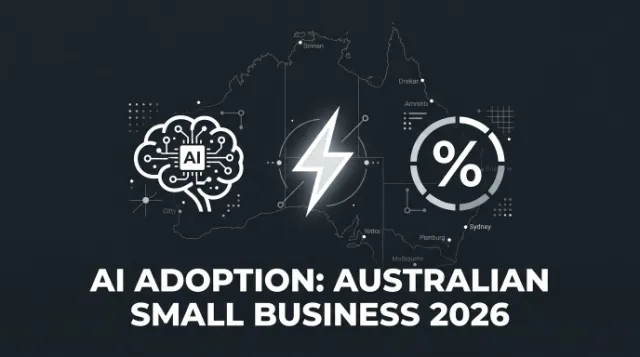
Deloitte Access Economics put out a report late last year that doesn’t get talked about enough. They looked at more than a thousand Australian SMBs and found that businesses moving from basic to intermediate AI use could expect a 45% increase in profitability.
That’s not a marginal improvement. That’s a transformative one.
And MYOB’s research found that 52% of mid-market businesses reported revenue growth — businesses that, by the way, were also the ones prioritising technology investment.
Now, I’ll be careful here because correlation isn’t causation. Businesses with more resources can invest in AI and are also more likely to grow for other reasons. But the gap is real, and it’s getting wider.
Let’s Make This Concrete
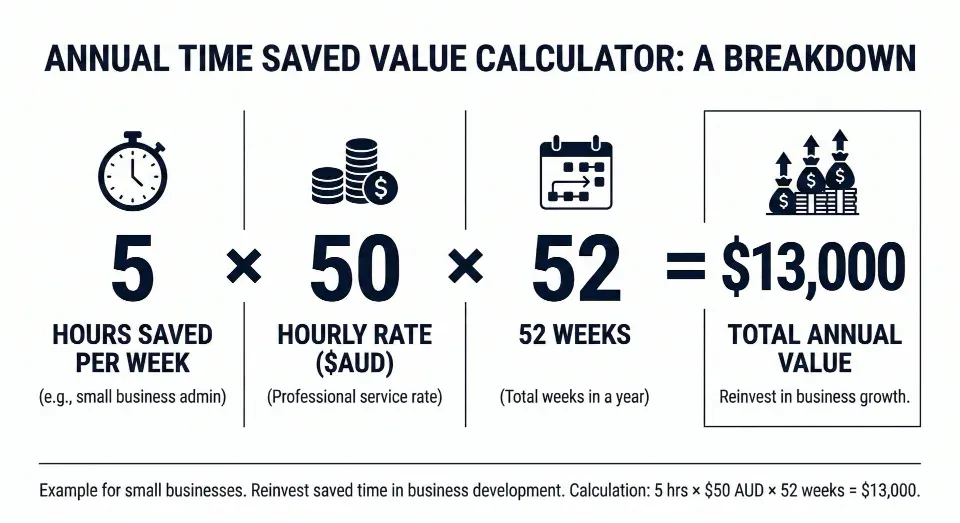
Say you run a service business — trades, professional services, retail, whatever. And let’s say AI tools could genuinely save you 8 hours a week. That’s a conservative number based on what I see with business owners who actually start using this stuff. (We mapped it out tool by tool in 5 AI Tools That Will Save Your Small Business 10 Hours a Week.)
At $75 an hour (a rough cost for your time or what you’d pay someone to do it), that’s $600 a week. $31,200 a year.
That’s not money you’re spending. That’s money you’re not getting back by not using a tool that, in most cases, costs less than $50 a month. And those savings multiply when you set up Claude Skills to eliminate the time wasted re-explaining your preferences in every conversation.
The maths aren’t complicated.
The Compounding Problem
Here’s the part that matters more in the long run.
The businesses adopting AI now are getting faster. Faster at content. Faster at customer communication. Faster at quoting, following up, producing proposals. They’re doing more with less.
The businesses waiting are still running at the same pace they were two years ago.
That gap compounds. Slowly at first, then quickly.
Right now, in most industries, you’re probably not far enough behind that it’s urgent. But the window of “comfortable to ignore” is genuinely closing.
The Objections I Hear Most
“I don’t have time to learn new tools.”
Fair. But if the tool saves you 8 hours a week once you’re using it, you’ll recover your learning time in the first week or two. The problem isn’t really time — it’s that the payoff feels abstract until you’ve actually tried it.
“The outputs aren’t good enough.”
They’re not perfect, and they do need editing — we wrote a whole guide on how to edit AI content so it sounds like you. But a slightly rough draft in 30 seconds is almost always more useful than a perfect document you’ll get to next week.
“My business is different / my clients expect human communication.”
Your clients expect good, timely communication. If AI helps you do that faster, they won’t know or care. The ones who care are the ones getting no response because you’re too busy to write it.

The Bottom Line
Not using AI isn’t a neutral choice right now. It’s a choice to keep doing things the slow way while a growing number of your competitors do them faster.
That might be fine for another six months. Probably not fine for another two years.
The good news: the starting point is genuinely low. One tool, one problem, a few hours of experimentation. Not a full system overhaul. We explain exactly where to start if you’re ready to stop waiting. And if you’re also thinking about improving your online presence, check whether your website is costing you customers — because AI tools work best when they’re backed by a solid site.
If you want to understand what this actually looks like for your specific business — not in theory, but in practice — reach out. That’s a conversation I have a lot and it doesn’t take long.