Ki-Carma
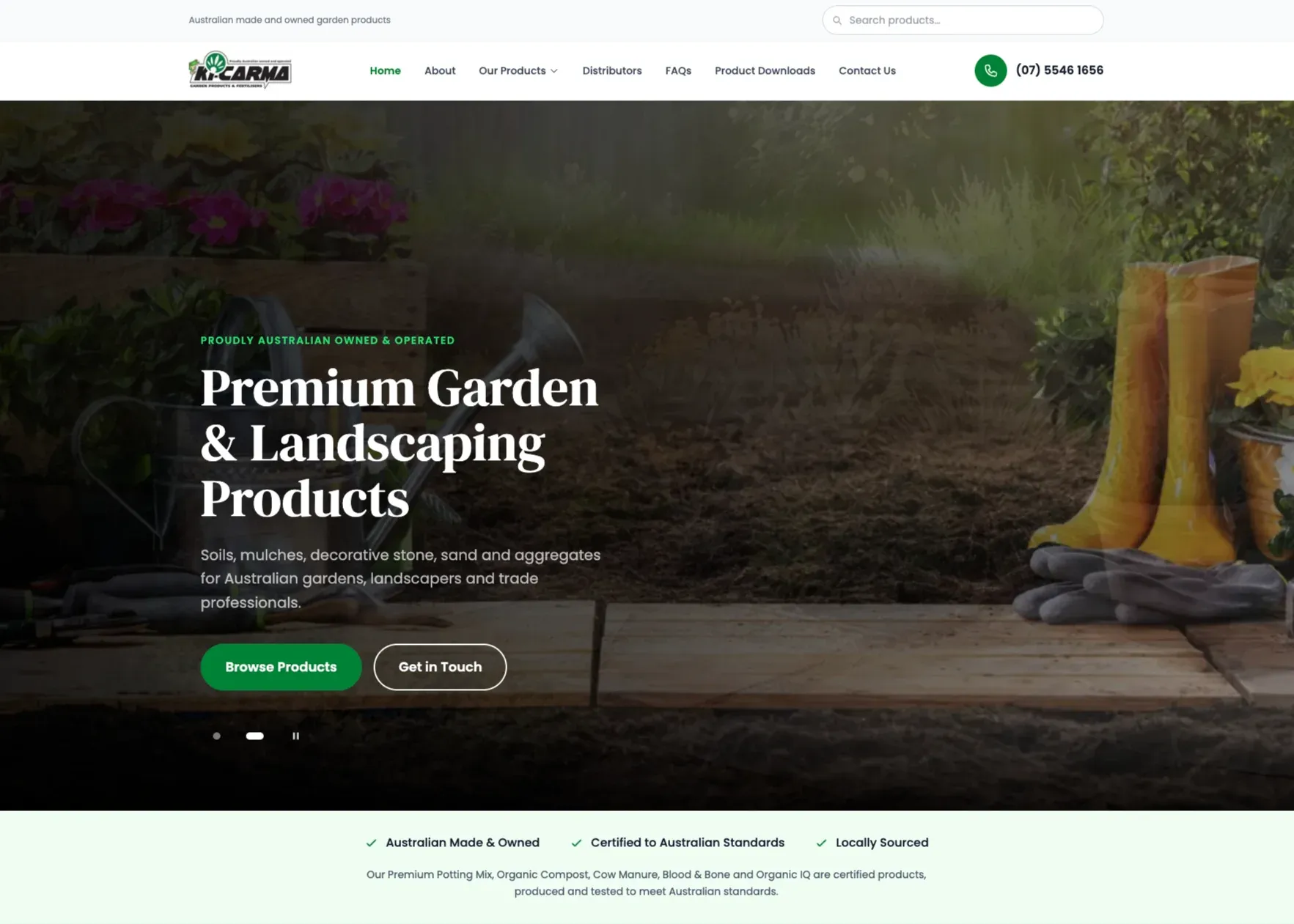
A WordPress rebuild for an Australian garden and landscaping products distributor, with automated safety data sheet handling and a searchable stockist locator that both stay current from the client's own spreadsheets.
The Challenge
Ki-Carma has been distributing Australian-made garden and landscaping products since 1997 — soils, mulches, fertilisers, decorative stone, sand and aggregates, sold through retailers including Bunnings. Their website isn’t a shop. It has two jobs: be the authoritative source of product information, and give retailers a way to research the range and get in touch about becoming a stockist.
Their old WordPress site wasn’t broken, exactly. The problem was subtler and more expensive than that: nobody at Ki-Carma could safely update it. Every change carried a risk of breaking something, so changes stopped happening. Product lines that had moved on were still listed. Information had aged. And critically, so had the safety data sheets — documents that have to be current, because people handle these products for a living.
A website that can’t be updated doesn’t stay still. It goes stale, and in this case the stale content included the part that matters most.
Here’s what they were working with:

Four navigation items. No product search, no distributor locator, no downloads section.
The Solution
I rebuilt the site on Astro as a fast, static-first build with no database and no admin login to attack. But the platform was the easy part. The real work was making sure the information on the site can never go stale again — by taking the updating out of Ki-Carma’s hands without taking away their control.
Safety data sheets that update themselves
This was the centrepiece. Ki-Carma drops in a new data sheet and the system takes it from there: it checks the incoming document against what’s already published and replaces the old version.
The genuinely tricky part is that a single safety data sheet often covers several product lines. Manually working out which products each new sheet belongs to is exactly the kind of tedious, error-prone job that gets skipped — and skipping it is how a site ends up serving outdated safety information. So the system reads the document itself and applies it to every relevant product automatically. No spreadsheet of mappings to maintain, no products quietly left pointing at a superseded sheet.
A stockist locator, driven from a spreadsheet
The old site had no distributor list at all, because maintaining one looked like more trouble than it was worth. That’s a real loss for a business selling through retail: stockists want to see who else carries a product, and customers want to know where to buy it.
The new locator is searchable by postcode, state or store name, and it accounts for the fact that not every stockist carries every line. Ki-Carma maintains it in a Google Sheet — they edit the spreadsheet they were already comfortable with, and the site picks up the changes.
The rest of the build
- Full catalogue migration — more than 80 products brought across from WordPress with nothing lost
- Instant product search — results appear as you type, matching on product name, description and category, with thumbnails so people recognise the bag they’re looking for
- Copywriting — the range rewritten for the two audiences the site actually serves: gardeners looking for the right product, and retailers assessing whether to stock it
- Keyword and SEO groundwork — page structure and copy built around how people search for soils, mulches and fertilisers, rather than around the old site’s structure
- FAQs and a downloads library — two sections the old site didn’t have, both of which absorb enquiries that used to come in by phone
- Mobile-first design — the site works cleanly on phones, tablets and desktops
Ownership, Not Lock-In
Two things about how this project was set up that matter more than any feature:
Ki-Carma are on the website maintenance package, which covers all ongoing content updates for one fixed price. No per-change quotes, no deciding whether a small update is worth paying for — which is precisely the calculation that let the old site go stale.
And they own the codebase. If they ever want to take it to another developer, they can. That’s how it should work: clients should stay because the service is good, not because leaving is painful.
What Astro Made Possible
The project ran on the client’s schedule, and by mid-year it needed a firm deadline. I took ownership of driving it, set end of July as the line, and worked alongside their team to get everything over it.
What made that achievable was the stack. Several additional features were added in the final two weeks of the build — the kind of late-stage scope that would normally push a launch date out by a month. On a traditional WordPress site, with plugins to reconcile and a theme to fight, it would have. On Astro it was just more code.
The Results
- 100/100 PageSpeed on desktop and over 90 on mobile
- Safety information stays current automatically, with new data sheets applied to every relevant product without manual mapping
- A stockist network that’s finally visible, searchable by postcode, state or store name, with per-location product availability
- The full product catalogue migrated from WordPress with nothing dropped in the move
- A site the client can’t break and doesn’t have to touch — content updates are covered, and the codebase is theirs
- Launched to a fixed deadline with late-stage features included rather than deferred
Product image updates are rolling out over the month following launch, building on the same drop-in-and-it-handles-it approach used for the data sheets.